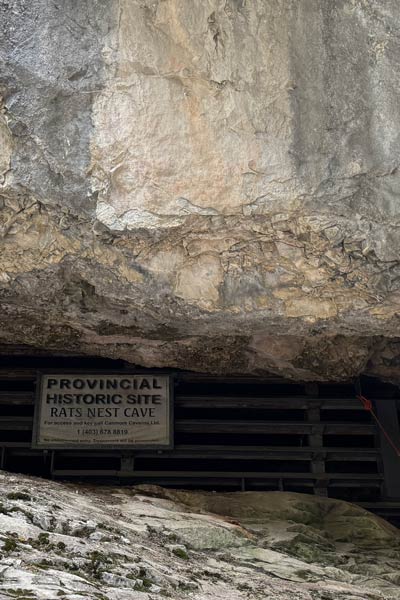
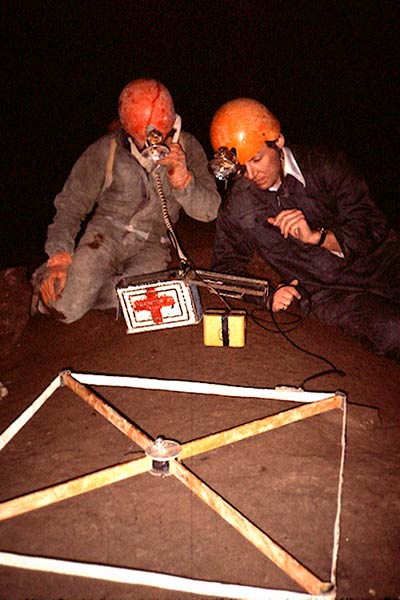
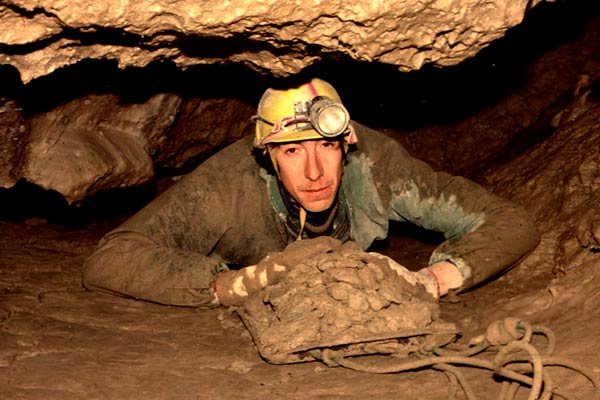
Rat's Nest Cave sits beneath Grotto Mountain on the edge of Canmore, Alberta — less than 20 minutes from Banff and at the gateway to Kananaskis Country in the Canadian Rockies' Bow Valley. It is one of the most scientifically significant caves in Canada, and one of the very few natural cave systems in the country designated a Provincial Historic Resource under Alberta's Historical Resources Act. Its passages encode the deep history of a continent: ancient tropical oceans, the grinding advance and retreat of ice ages, a bone-filled pit spanning thousands of years of wildlife history, and the presence of indigenous peoples long before European explorers set foot in the Rockies. This is not a cave that simply exists. It is a cave that remembers.
Geology of Rat's Nest Cave: Origins 360 Million Years Ago
The story of Rat's Nest Cave begins not in Alberta, but in a warm, shallow ocean sitting just north of the equator. Around 360 million years ago, during the Devonian and early Carboniferous periods, the landmass that would eventually become western Canada lay beneath a tropical sea — part of the vast Panthalassan Ocean bordering the supercontinent of Laurasia. Coral reefs thrived here, populated by crinoids (sometimes called sea lilies, though they are animals, not plants), brachiopods, and a rich assortment of marine life.
Over millions of years, the remains of these organisms accumulated on the seafloor, compressing under their own weight into the thick limestone layers known today as the Livingstone and Mount Head formations. These are the same imposing cliffs you see towering over the town of Canmore. They are, quite literally, an ancient seabed lifted skyward.
The plate tectonics that followed were titanic in scale. Continental collisions eventually assembled the supercontinent of Pangaea, which then began to fracture around 200 million years ago. As the Atlantic Ocean opened and North America drifted northwest, the continent's western edge crumpled against volcanic island chains rising from the Pacific floor. The result — playing out over tens of millions of years — was the Canadian Rocky Mountains. The compression created deep faults in the limestone, lines of weakness that would, in time, become the pathways for water. Those pathways would eventually become Rat's Nest Cave.
Latest Posts
How Rat's Nest Cave Formed: Faults, Water, and Ice
Cave formation is a slow, patient process. Slightly acidic groundwater — rainwater and snowmelt charged with carbon dioxide absorbed from the atmosphere and soil — percolates down through the rock, attacking the calcium carbonate in the limestone and dissolving it molecule by molecule. Given enough time and the right structural conditions, this quiet chemistry widens fractures into passages, passages into chambers.
For Rat's Nest Cave, the critical structural feature was a thrust fault — a very low-angled fracture running through the Grotto Mountain limestone, formed during the final phases of mountain building around 45 to 85 million years ago. Water found this fault and began to work. For tens of millions of years, the cave grew slowly beneath the water table, the passages forming in the classic rounded, tube-like shapes characteristic of phreatic (water-filled) conditions. Scalloping patterns still visible at the cave entrance record the turbulent flow of water that once rushed through.
Then came the ice ages. Beginning around 1.6 million years ago, repeated glaciations dramatically altered the landscape of the Bow Valley. Glaciers advancing down the valley deepened and widened it, changing the course of rivers, dropping the water table, and dramatically accelerating the evolution of the cave. As the water table fell, the cave drained and shifted from phreatic to vadose (air-filled) conditions — the phase in which the mineral formations we associate with caves begin to grow. Glacial meltwaters flushed sediments into the passages. Ice plugs formed in the deeper reaches. The cave became a dynamic, shifting archive of the climate itself.
Today, the cave extends more than 4 kilometres into the mountain — a three-dimensional maze of passages, chambers, tubes, and shafts, all formed along that original fault system. The entrance sits at approximately 1,800 metres elevation, and the cave descends to around 1,500 metres. It maintains a near-constant temperature of 4.5°C year-round, and because it never freezes, it has served for thousands of years as a refuge for insects, bats, rodents, and — as we will see — much more.
Wait... the cave is always 4.5°C? Find out why...
Speleothems and Climate Science: Rat's Nest Cave's 766,000-Year Record
Among the most scientifically compelling aspects of Rat's Nest Cave are its mineral formations — the stalactites, stalagmites, flowstone, curtains, and soda straws that have been building, dissolving, and rebuilding for hundreds of thousands of years. These formations, collectively called speleothems, are not merely beautiful. They are precise natural archives of the climate.
Speleothems form when groundwater seeping through the limestone bedrock loses carbon dioxide upon entering the open cave air, causing dissolved calcium carbonate to precipitate as calcite. They grow in layers — sometimes thickly during warm, wet interglacial periods; barely at all, or not at all, during glaciations when the ground above freezes and the supply of seeping water shuts down. These growth interruptions are as informative as the growth itself.
Using uranium-series dating — a radiometric technique that measures the ratio of uranium isotopes to their radioactive decay products, thorium and protactinium — researchers have been able to date speleothems from Rat's Nest Cave to ages ranging from 3,800 years to approximately 766,000 years before present. This range is among the most complete Quaternary records documented from any cave in Canada, placing Rat's Nest Cave in rare scientific company. One stalactite, catalogued as 881010, records at least five distinct phases of growth separated by glacial flood events — each inundation leaving a mud coating, each interglacial period leaving new calcite layers. Its cross-section reads like a stratigraphic column of the Pleistocene.
The speleothems also contain trace amounts of organic acids that exhibit a phenomenon known as luminescence — they glow faintly when exposed to ultraviolet light. Remarkably, the intensity of this luminescence correlates with past solar activity, and instruments sensitive enough to detect annual variation in the sun's output have been used to study samples from this cave. Work by researcher Yavor Shopov demonstrated that single-year solar cycles could be resolved within individual growth layers — so-called Shopov Bands — a level of resolution that transformed speleothem climate research internationally. The cave's record has since been incorporated into continental-scale climate studies alongside sites in Europe and North America.
What does this record tell us? In broad terms, the cave's speleothem history confirms the pattern of glacial and interglacial cycles seen in deep-sea sediment cores and Antarctic ice cores. But it provides a uniquely regional perspective — anchored in the Bow Valley — that contributes something no other archive can: a local signal from the heart of the Canadian Rockies, spanning nearly three-quarters of a million years.
Want to learn more about speleothems? Check out this article.
-

Draperies
Calcite draperies in Rat's Nest Cave, their banded "streaky bacon" colouring the result of trace organics and minerals carried by seeping groundwater over thousands of years. Each layer records a slightly different chemical environment at the time of deposition — a visible archive of conditions at the surface far above.
-

Soda Straws
Soda straw stalactites hanging from the ceiling of Rat's Nest Cave. These hollow tubular formations grow as water travels down through a central channel, depositing a thin ring of calcite at the tip with each drop. Research at the cave has determined that soda straws here grow approximately 30 centimetres over 2,000 years — making even the smallest formation a significant piece of natural history.
-
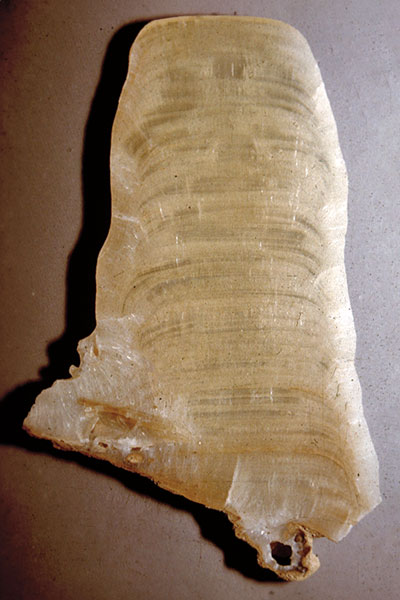
Stalagmite Cross-Section
A cross-section through a stalactite from Rat's Nest Cave, revealing distinct growth layers laid down over hundreds of thousands of years. Gaps in the banding record glacial periods when permafrost shut down the supply of seeping groundwater entirely. Using uranium-series dating, researchers have read formations like this one as a climate record extending back nearly 766,000 years — among the most complete Quaternary archives from any cave in Canada.
-

The Grotto
The Grotto, one of the most heavily decorated chambers in Rat's Nest Cave. Multiple water sources converge here, producing an exceptionally dense concentration of speleothems — stalactites, stalagmites, flowstone, curtains, and soda straws forming in a space where dripping, flowing, seeping, and pooled water have all left their mineral signatures. The Grotto is also the site of the cave's flooded siphon, first dived in 1979.
The Bone Bed: Rat's Nest Cave's Paleontological Record
Near the cave entrance, a 15-metre shaft drops into the mountain. At the base of this pit lies one of the most remarkable paleontological sites in Alberta: the Bone Bed, a two-metre-thick stratigraphic sequence of frost-shattered rock, soil, and bones — thousands of them, accumulated over at least 3,000 years.
The pit is a natural trap. Animals that wandered too close to the entrance — or were deliberately disposed of there by human visitors — fell in and did not get out. Over millennia, layers built up. Palaeontologist Dr. James Burns of the Royal Alberta Museum conducted a preliminary assessment of the assemblage in 1986, and the species list he documented reads like a census of the Holocene Rockies: Canadian gray wolf, black bear, lynx, wolverine, pine marten, coyote, swift fox, badger, mink, bighorn sheep, pika, and numerous rodent and bird species including golden eagle, passenger pigeon, and crow.
One particular specimen — a gray wolf jawbone extracted from roughly halfway down the sequence — was assessed at approximately 3,000 years old. The full depth of the deposit may extend the record considerably further back. Each layer is a snapshot of the animal community that inhabited the Bow Valley at a given moment, and the sequence as a whole captures the post-glacial reestablishment of wildlife in the region following the retreat of the last great ice sheet around 11,000 years ago.
The Bone Bed does not only contain wildlife remains. Human activity is encoded there too — worked animal bones, tool fragments, and other cultural material associated with the indigenous peoples who used the site. An osprey that apparently flew into the cave carrying a fish from the Bow River left behind a complete fish skeleton. Layers of fossil rodent middens interleave with the larger bones. The pit has been described as potentially the best-documented mid- to late-Holocene environmental record anywhere in Alberta — a distinction that underscores both its scientific value and the importance of preserving what remains of it undisturbed.
-
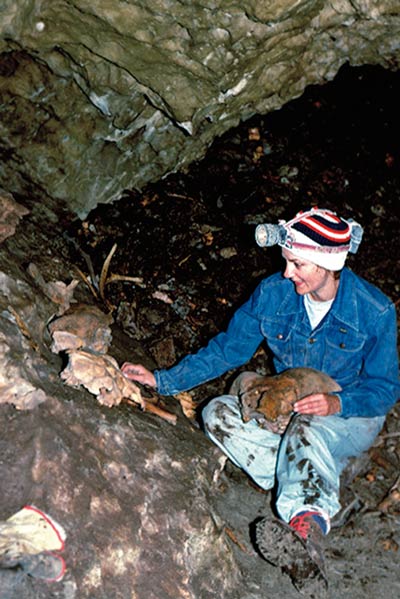
Bone Bed Bones
Skulls and bones spilling from the base of the Bone Bed pit into the horizontal passage beyond. The assemblage — accumulated over at least 7,000 years at the base of the cave's 15-metre entrance shaft — includes the remains of 34 mammal species, making it one of the most significant Holocene vertebrate fossil sites in Alberta.
-

Bone Bed Excavation
Paleontological excavation of the Bone Bed at Rat's Nest Cave. The two-metre-thick deposit of frost-shattered rock, soil, and bones represents a continuous stratigraphic record of wildlife in the Bow Valley spanning thousands of years — layer by layer, a census of the animals that inhabited this landscape from the end of the last ice age onward.
-

Bone Bed Skull
A large mammal skull recovered from the Bone Bed, one of hundreds of specimens documented by Dr. James Burns of the Provincial Museum of Alberta. The deposit contains remains of species no longer present in the Bow Valley, including the gray wolf, wolverine, and swift fox — animals whose presence here speaks to a wilder, less fragmented landscape than exists today.
-
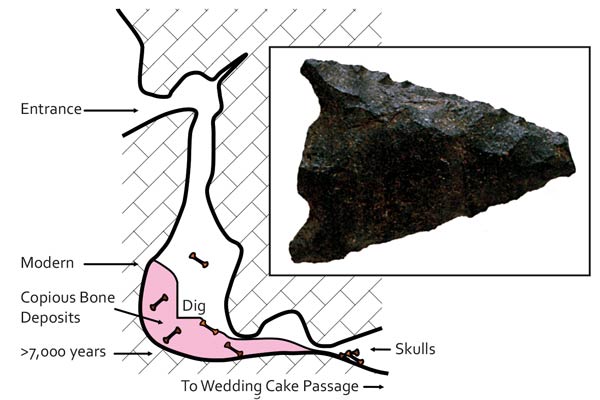
Bone Bed Cross Section
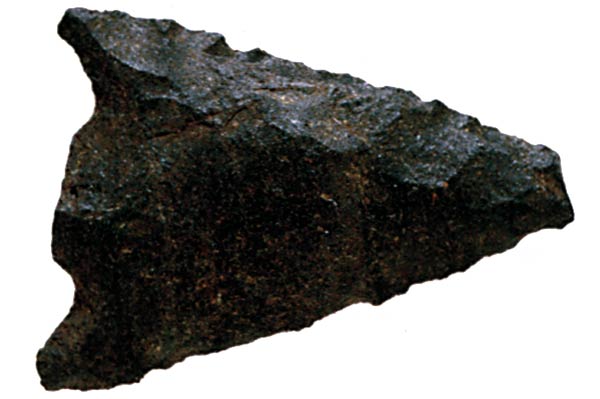
Cross-section of the Rat's Nest Cave entrance shaft showing the location and extent of the Bone Bed deposit, with bone-bearing layers extending more than 7,000 years into the past. Inset: a Pelican Lake style projectile point recovered from the cave, one of only two prehistoric stone tools found at the site, dated to approximately 1350 BC–100 AD and likely made from obsidian originating in Oregon or Washington.
Indigenous History at Rat's Nest Cave: The Pelican Lake People
People have known about Rat's Nest Cave for a very long time. Archaeological evidence indicates that humans have occupied the Bow Valley region continuously from at least 10,500 years before present, with the possibility — suggested by finds at the Vermilion Lakes site near Banff — of much earlier presence during warmer interludes of the mid-Wisconsin glaciation, 60,000 to 25,000 years ago.
The cultural group most directly associated with the cave is the Pelican Lake people, who occupied the Alberta Plains and foothills roughly 3,000 to 3,500 years ago. They are sometimes called the 'Renaissance People of the Plains' for the sophistication of their culture and trade networks — their tools include obsidian projectile points whose stone originated in sources far to the south and west, indicating long-distance exchange relationships reaching across the continent.
Material recovered from the Bone Bed pit — including worked bone, prepared deer hides, and tool fragments — suggests that the cave was a functional site: a place where meat was processed and stored, waste discarded, and perhaps ceremonies conducted. Above the entrance shaft, the faint ghost of an ochre smear may represent the remnants of pictographs, partially effaced over centuries by vapour rising from the warm cave below.
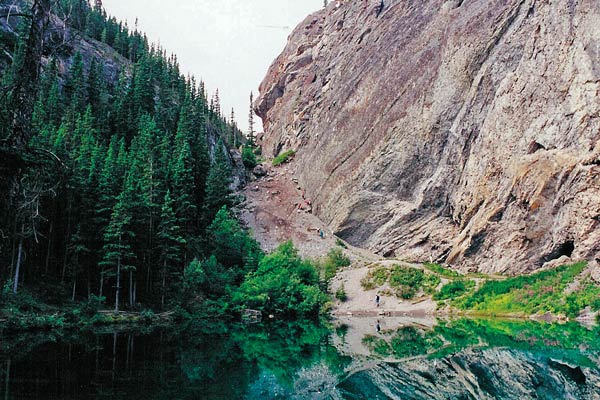
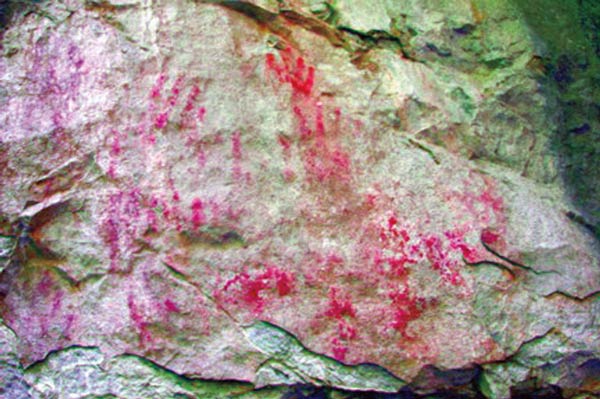
A short distance away, the walls of Grotto Canyon — which defines the eastern margin of Grotto Mountain — bear well-preserved pictographs, a reminder that this entire landscape carried spiritual and cultural significance to the peoples who inhabited it. Rat's Nest Cave was not an anomaly in that world. It was part of it.
Rat's Nest Cave isn't the only place to see pictographs... learn more
Modern Exploration of Rat's Nest Cave
The modern chapter of the cave's story begins in the early 1970s, when rumours among mountain climbers in the Banff and Canmore area spoke of a cave on Grotto Mountain — then sometimes called 'Grotto Cave,' a name still occasionally used. The Alberta Speleological Society (ASS), active since the early 1960s, investigated the rumours and made the first serious exploratory forays into the system.
Those early trips, led in part by figures including Alfie Cawthorpe and John Donovan, mapped the main tour-side passages: the entrance, the large boulder-floored chamber below the entrance shaft, the moonmilk-coated pitch, and the routes connecting toward the Grand Gallery. The cave seemed to promise more, and it delivered. Subsequent expeditions pushed through increasingly technical terrain — through the infamous Laundry Chute, a body-sized constricted tube requiring full commitment to enter; along the Hosepipe Passage, a flat-out crawl through water; and through the Birth Canal, a squeeze leading to previously uncharted sections.
In 1979, attention turned to the flooded siphon at the Grotto — a section where the passage dips below water. Cave diver Paul Hadfield made the first successful crossing of this submerged section, entering 5°C water in full scuba gear and surfacing on the far side after a technically demanding 15-metre dive. Later expeditions pushed through a second, more constricted sump of 18 metres, finding large rounded passages beyond trending downward into unexplored territory.
Exploration continued through the 1980s and into the 2000s. The discovery of the Wedding Cake Passage — named for a distinctive stalagmite formation — led to the breakthrough that connected previously separate sections of the system. New passages were found beyond the Grand Gallery, and climbs were established into dome-like sections of ceiling passage following the fault line deeper into the mountain. By 2012, the cave had been documented to more than 4 kilometres in length, and with numerous unexplored leads still identified, the full extent of the system almost certainly remains unknown.
Rat's Nest Cave is unique among Rockies caves for its accessibility — less than 2 kilometres of hiking from the trailhead, a modest 180 metres of elevation gain — and for its relative warmth and structural stability. Most significant caves in the Canadian Rockies require multi-day alpine approaches, vertical exposure to frost-shattered rockfall, and temperatures far below freezing. Rat's Nest, by contrast, is a cave that can be fully experienced, within a single day, by people willing to commit to the physical demands of genuine caving.
Find the idea of exploration exciting? Read about the Yorkshire Pot expedition
Provincial Historic Resource: Protection and Conservation
In March 1987, Rat's Nest Cave was formally designated a Provincial Historic Resource under Alberta's Historical Resources Act — one of very few natural cave systems in Canada to hold that status. The designation came after years of effort by cave researcher and author Charles Yonge and his partner Tonny Hansen, who lobbied the province following a systematic inventory of the cave's contents. The process was supported by grants from the Alberta Historic Resources Foundation and the Alberta Environmental Trust, and the scientific findings — particularly from Dr. James Burns' paleontological assessment of the Bone Bed — made a compelling case for protection. The designation covers a square-mile area around the cave entrance.
The designation matters for a specific reason: the cave entrance sits within an industrial lease held by Graymont Western Canada Inc., the limestone quarrying company that operates on Grotto Mountain. Graymont's quarry — visible as a prominent scar on the mountain's flank when viewed from Canmore — is located approximately 1.5 kilometres from the cave entrance. As the leaseholders, Graymont serves as site custodians under the historic designation. The protection status, combined with a negotiated management agreement and a permit from Alberta Sustainable Development, established the framework under which guided access to the cave is possible today.
The relationship between industrial land use and cave conservation is an unusual one, but it has proven workable. Graymont's primary concern was liability — quarry blasting occurs several times a year on the mountain — and an independent consultant assessed that blasting at that distance poses no meaningful risk to the cave's interior or its formations. That assessment cleared the way for a formal access and management agreement. Over more than three decades of guided operations, no blasting-related incidents have occurred at the cave. Graymont also funded the installation of a specially designed gate at the cave entrance — built with spacing that allows bats and wood rats to pass freely — which prevents unmanaged access while preserving the cave's ecological function.
The Provincial Historic Resource designation carries real teeth. It protects the cave's geological features, its speleothems, its sediment stratigraphy, its paleontological and archaeological material, and its living ecosystem from disturbance or removal. The Historical Resources Act makes damage to a designated site a legal offence. Combined with active on-site management, this framework has kept the cave in substantially better condition than many comparable sites, where uncontrolled access has resulted in broken formations, disturbed bone deposits, and graffiti. The designation is not merely a plaque on a wall — it is the legal and institutional structure that makes responsible access to the cave possible at all.
Frequently Asked Questions About Rat's Nest Cave
-
Where is Rat's Nest Cave located?
Rat's Nest Cave is located beneath Grotto Mountain near Canmore, Alberta, in the Bow Valley of the Canadian Rockies. It is approximately 10 minutes east of the town of Canmore, 25 minutes from Banff, and sits at the western edge of Kananaskis Country. The cave entrance is accessible via a short hike of less than 2 kilometres from the trailhead, gaining approximately 180 metres in elevation. The Trans-Canada Highway (Highway 1) runs through the Bow Valley below, making the cave one of the most accessible significant cave systems in the Canadian Rockies.
-
How long is Rat's Nest Cave?
The known extent of Rat's Nest Cave is more than 4 kilometres of mapped passage, making it one of the longer cave systems in Alberta. The cave is a three-dimensional maze of passages, chambers, tubes, and shafts. Its full extent is not yet known — as of 2012, numerous unexplored leads had been identified, and further passages are likely still to be discovered within Grotto Mountain.
-
How old is Rat's Nest Cave?
The limestone rock in which the cave formed originated as tropical coral reef deposits approximately 320 to 360 million years ago during the Devonian and early Carboniferous periods. The cave itself began forming after the Canadian Rocky Mountains were built, roughly 45 to 85 million years ago, as groundwater began to dissolve the faulted limestone. Speleothem (mineral formation) deposits within the cave have been dated to as old as 766,000 years before present using uranium-series dating, providing a climate record spanning the majority of the Pleistocene ice ages. Human presence at the cave has been documented to at least 3,000 years ago.
-
Is Rat's Nest Cave protected?
Yes. Rat's Nest Cave was designated a Provincial Historic Resource under Alberta's Historical Resources Act in March 1987 — one of very few natural cave systems in Canada to hold this status. The designation covers a square-mile area around the cave entrance and legally protects the cave's geological features, speleothems, paleontological and archaeological material, and living ecosystem. The cave entrance is located within a lease held by Graymont Western Canada Inc., the limestone quarrying company that operates on Grotto Mountain, which serves as site custodian under the historic designation. A management agreement between the province, Graymont, and the cave operators governs all access to the site.
-
What animals live in Rat's Nest Cave?
The cave supports a variety of wildlife year-round. The most visible residents are bushy-tailed wood rats (pack rats), whose middens are found on ledges throughout the entrance area, and occasional little brown bats, which use the cave as a hibernaculum. The stable above-freezing temperature makes the cave an important winter refuge for insects including mosquitoes, gnats, harvestmen (daddy-long-legs), crickets, and beetles. Researchers have also identified asellid isopods (a type of small crustacean, Salmasellus steganothrix) living in the cave's water features — organisms that are adapted to subterranean aquatic environments. The cave's Bone Bed records the remains of 34 mammal species that have inhabited the Bow Valley over the past 7,000 years, including gray wolf, black bear, lynx, wolverine, coyote, and the now-locally-extinct swift fox.
-
Is Rat's Nest Cave near Banff?
Yes. Rat's Nest Cave is located approximately 25 kilometres east of the town of Banff, or roughly a 20-25 minute drive along the Trans-Canada Highway. It sits just outside Canmore, which borders Banff National Park to the east. While the cave itself is not within the national park boundaries, it is part of the same mountain landscape — formed in the same Carboniferous limestone, shaped by the same glacial history, and set within the broader Bow Valley corridor that connects Banff, Canmore, and the gateway to Kananaskis Country.
-
What makes Rat's Nest Cave scientifically significant?
Rat's Nest Cave is considered one of the most scientifically significant cave systems in Canada for several overlapping reasons. Its speleothems (mineral formations) provide a climate record extending back approximately 766,000 years — among the most complete Quaternary records from any cave in the country. The cave's Bone Bed is potentially the best-documented mid- to late-Holocene vertebrate fossil site in Alberta, with 34 identified mammal species spanning 7,000 years. Its archaeological material provides evidence of indigenous use dating back at least 3,000 years. And research conducted at the cave contributed to internationally recognized advances in speleothem climate science, including the identification of annual solar cycles preserved in cave mineral layers (Shopov Bands). The cave's Provincial Historic Resource designation reflects this accumulated scientific value.
A Place That Has Always Mattered
What makes Rat's Nest Cave extraordinary is not any single feature, but the convergence of so many. It is a geological archive spanning hundreds of millions of years — from tropical Carboniferous reef to glacially-carved mountain. It is a climate laboratory whose speleothems hold a nearly three-quarter-million-year record of regional temperature and precipitation. It is a wildlife repository containing the bones of animals that have not been seen in this valley for centuries. It is an archaeological site where people processed meat, discarded tools, and possibly performed ceremonies thousands of years before Europeans arrived in the Rockies.
Alberta recognized this convergence in 1987, when the cave received its Provincial Historic Resource designation — a status it retains to this day. The designation reflects not only the age of what lies inside, but the irreplaceability of it. Every formation broken, every sediment layer disturbed, every bone displaced is a page torn from a book that took millions of years to write.
The cave is still here. The fault that started everything is still there in the rock. The stalactites are still growing, one infinitesimal layer at a time, adding to a record that will eventually be read by scientists we cannot yet imagine. Grotto Mountain still stands over the Bow Valley, keeping its cave in the dark.
Experience Rat's Nest Cave for Yourself
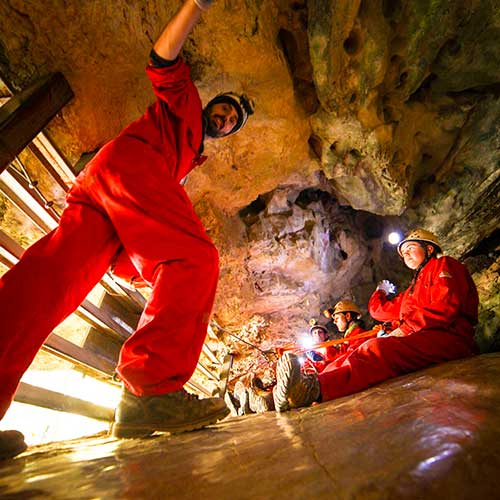
Rat's Nest Cave is open for guided tours year-round, departing from Canmore — less than 25 minutes from Banff. Two tour options are available: the Explorer Tour spends 2.5 hours underground passing ancient bones and cave formations, while the Adventure Tour adds an 18-metre rappel and a full 4 hours beneath the mountain. Tours are available to ages 10 and up (Explorer)/12 and up (Adventure), and all equipment is provided. No caving experience is required — only a moderate level of fitness and a sense of adventure.